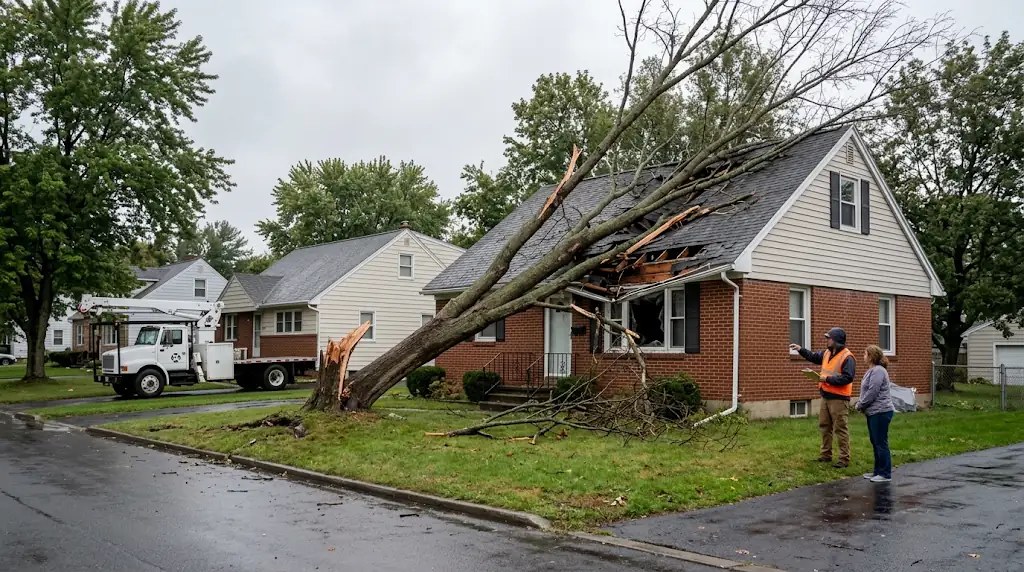
A heavy winter ice storm sweeps across Oneida County, or a violent summer squall barrels down the Mohawk River. You wake up to a deafening thud and find an eighty-foot maple sprawled across your driveway, deck, or roof.
Once you confirm everyone is safe, the immediate financial question sets in: Will my homeowner’s insurance pay to remove this tree?
The short answer is: Sometimes, but it depends almost entirely on where the tree landed and why it fell.
Many homeowners throughout Utica, Rome, and neighboring suburbs assume that any fallen tree qualifies for an insurance payout. In reality, insurance companies have very strict guidelines about what they consider a covered loss versus regular property maintenance.
At Utica Tree Removal, we regularly work with insurance adjusters across the Mohawk Valley. Here is a straightforward breakdown of how homeowner’s insurance treats tree removal, what will be paid for, what comes out of your pocket, and the common pitfalls that lead to denied claims.
Scenario 1: The Tree Falls on an Insured Structure (Usually Covered)
If a tree or heavy limb crashes into your home, attached garage, detached workshop, shed, or perimeter fence, your homeowner’s insurance policy will almost always kick in.
Standard policies (such as HO-3 policies commonly written in New York) cover the damage caused by “perils” like high winds, lightning strikes, ice accumulation, and heavy snow loads.
In this situation, your insurance coverage typically splits into two parts:
- Structure Repair: Paying to fix the structural damage to your rafters, shingles, siding, gutters, or fence.
- Debris Removal: Paying an insured contractor to safely cut the tree off the structure and haul the wood away.
The Debris Removal Limit
It is important to check the fine print of your policy regarding debris removal limits. Most carriers cap the removal benefit at $500 to $1,000 per tree, often with a total cap of around 5% of your total dwelling coverage for an entire storm event.
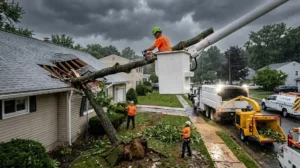
If a massive, five-ton oak tree requires a crane to safely hoist individual sections off your roof in New Hartford without causing secondary structural collapse, the bill for crane operations and emergency rigging can exceed standard debris limits. However, if the tree removal is necessary to access and repair the roof damage, insurance companies often allocate those specialized extraction costs under the broader dwelling repair budget.
When structural damage occurs, call for emergency tree removal services immediately so the crew can tarp the roof, prevent rain from flooding your interior, and document the damage before moving heavy timber.
Scenario 2: The Tree Falls Harmlessly on the Lawn (Rarely Covered)
Imagine a severe windstorm blows through Marcy or Whitesboro, snapping a mature pine at the base. The tree falls cleanly across your front lawn, missing your house, your car, and your fence by ten feet.
Will insurance pay to cut it up and haul it away?
In 90% of cases, no.
Homeowner’s insurance is designed to protect your physical dwelling and insured structures, not your landscaping. If a fallen tree causes zero structural damage, insurance companies consider its removal to be routine yard cleanup and landscaping maintenance, which is entirely the homeowner’s out-of-pocket responsibility.
The Critical Exceptions
There are a couple of specific situations where insurance will step in even if a house wasn’t hit:
- Blocking Your Driveway: If the tree fell across your driveway, completely preventing you from driving your personal vehicles in or out of your property, many policies will cover removal up to the $500 or $1,000 debris limit.
- Blocking Handicap Ramps: If the fallen wood blocks a ramp or essential accessibility pathway to your home, removal is typically covered.
If neither of those exceptions applies, you will need to schedule standard residential tree removal directly with a local tree care company.
The “Act of God” vs. Neglect: Why Claims Get Denied
Insurance policies are built to protect against sudden, accidental occurrences—often legally termed “acts of God.” If a healthy, living tree snaps during a freak summer microburst, that is an unexpected event, and coverage applies.
However, adjusters will look closely at the condition of the wood. If an adjuster determines that the tree fell because it was already rotting, hollow, or dead before the storm hit, they may deny your claim on the grounds of homeowner negligence.
This has become a major issue across the Mohawk Valley due to the Emerald Ash Borer. Dead ash trees in places like Clinton, Frankfort, and Oriskany dry out quickly and turn brittle. If you have had a completely bare, barkless ash tree standing twenty feet from your roof for three seasons, your insurance company can argue that you had an obligation to remove that known hazard before it caused damage.
If they classify the fall as a failure to maintain the property, you could end up paying for both the tree removal and the roof repairs entirely on your own dime.
My Neighbor’s Tree Fell on My House: Whose Insurance Pays?
This is one of the most common disputes between neighbors in Oneida County.
If your neighbor’s tree snaps during a storm and crashes into your garage, common sense might tell you that your neighbor’s insurance policy should pay for it. After all, it was their tree.
New York property law says otherwise.
Under New York law, when a healthy tree falls due to severe weather, it is legally considered an act of God. Even though the tree was rooted on your neighbor’s property, your insurance policy covers the damage to your property. You will have to pay your standard deductible, and your insurance company will handle the repairs and debris removal.
When Is Your Neighbor Actually Liable?
Your neighbor is only legally responsible for the damage if you can prove they were negligent.
To establish negligence, you must have documentation showing:
- The tree was visibly dead, diseased, or hazardous.
- The neighbor knew—or reasonably should have known—about the danger.
- You officially notified them of the hazard (preferably via certified mail with date-stamped photos from a certified arborist) before the storm occurred.
If you have that paper trail, your insurance company will likely pay your claim and then pursue your neighbor’s insurer through a process called subrogation to recover the costs, including your deductible.
Does Insurance Pay for Stump Grinding?
Once the fallen tree is cleared away from your roof and yard, you are left with the root system and an unsightly stump.
Insurance adjusters almost universally draw the line at the ground level. Homeowner’s insurance policies do not cover stump grinding.
Insurance is strictly concerned with mitigating active structural risk and returning the property to a safe condition. A stump sitting flush with the soil does not threaten the framing of your roof or the structure of your garage. If you want the stump eliminated to restore your turf or prepare for replanting, you will need to pay for professional stump grinding services separately.
Steps to Take After Tree Damage Occurs
If a tree damages your property, handling the immediate aftermath properly protects both your home and your insurance claim:
- Document Everything First: Before anyone picks up a chainsaw or moves a branch, take wide-angle photos and detailed video of the damage from ground level. Capture how the tree is resting on the structure, the punctured roofing, and the point where the trunk snapped.
- Prevent Secondary Damage: Homeowners are legally required to mitigate further damage. If rainwater is pouring through a cracked rafter, get an emergency tree service on-site immediately to cut away limbs and tarp the openings. Keep all receipts for emergency tarping and stabilization.
- Call Your Insurance Agent: File your claim promptly and ask your adjuster what specific debris removal limits apply under your policy.
- Hire a Fully Insured Contractor: Never let an uninsured “cash-only” outfit handle storm-damage work. If an uninsured worker falls off your roof while clearing branches, you could face immense personal liability. Always hire an experienced crew that carries general liability insurance and workers’ compensation.
Get Fast, Professional Help for Mohawk Valley Storm Damage
Navigating property damage and insurance paperwork is stressful enough without having to worry about how to safely dismantle a multi-ton tree hanging over your bedroom.
At Utica Tree Removal, we provide prompt, fully insured tree services throughout Utica, Rome, and the surrounding Mohawk Valley. We know how to work seamlessly alongside insurance adjusters, provide clear itemized estimates, and safely clear dangerous wood with zero added property impact.
Whether you are dealing with a fallen tree emergency or want to remove a dead hazard before the next storm hits, contact our team today for a free on-site estimate. We are here to keep your home protected.