When a mature maple in New Hartford starts dropping dead limbs or an aging oak in Utica crowds your roofline, your first instinct is usually to find a way to save it. Mature trees provide shade, character, and curb appeal that take decades to grow. Naturally, most homeowners ask: “Can’t we just trim off the dead branches and leave the rest?”
Hoping a quick pruning job will solve the problem is completely understandable—pruning is almost always cheaper upfront than a full takedown.
However, there is a clear biological and structural line between a tree that needs a routine haircut and one that has become an active hazard. Spending money to trim a structurally compromised tree doesn’t save it; it just delays an inevitable, more expensive takedown while keeping your house in the crosshairs of the next storm.
At Utica Tree Removal, we believe in honest assessments. We won’t push you to cut down a healthy tree, but we won’t sugarcoat a hazard that threatens your roof, either.
Here is our practical guide to knowing whether your Mohawk Valley tree can be safely preserved through trimming or needs complete removal.
When Professional Trimming Makes Sense
Pruning isn’t just aesthetic maintenance; it is preventative health care for your property. If a tree’s root system is solid and its main trunk is healthy, targeted trimming solves most common residential issues.
You likely only need professional tree trimming and pruning if you are dealing with:
- Encroaching Roof Clearance: Branches scraping against asphalt shingles, resting on gutters, or shading the roof deck until moss forms. Pruning these branches back establishes a safe buffer without harming the tree’s health.
- Minor Canopy Dieback (Under 25%): If only a few small branches at the outer edges of the canopy have died while the rest of the foliage is vibrant and full, a simple crown cleaning will remove the deadwood safely.
- Overcrowded Canopies: Heavy summer windstorms can push against dense leaf canopies like a sail on a boat. Thinning out interior branches improves airflow, lets sunlight hit your lawn, and reduces wind resistance during storms.
- Long-Standing, Stable Leans: Not every leaning tree is falling. If a tree has grown toward the sun at a slight angle for thirty years and the surrounding soil is undisturbed, strategic weight-reduction pruning on the heavy side can keep it balanced for decades.
5 Red Flags: When Trimming Won’t Save the Tree
Pruning only works when the tree has the biological energy to heal its wounds and the structural integrity to hold itself up. When structural decay sets in, trimming branches is like putting fresh paint on rotted framing.
If you notice any of these five warning signs, complete residential tree removal is typically the only safe, permanent answer.
1. The 50% Canopy Rule
A tree relies on its leaves for photosynthesis to feed its root system. If more than 30% to 50% of the main canopy is bare, dead, or failing to leaf out in the spring, the tree is in irreversible decline. Pruning away the remaining dead limbs in an attempt to “clean it up” actually removes what little food-producing foliage remains, accelerating the tree’s death. Once half the canopy is gone, removal is necessary.
2. Hollow Trunks and Extensive Internal Rot
Look closely at the main trunk. Do you see large open cavities, peeling bark, or shelf-like fungal mushrooms (conks) growing near the base? Fungi only feed on dead or decaying wood fibers.
While a tree can survive with minor internal hollows, it becomes a structural risk when more than one-third of the trunk’s interior diameter is rotted away. Pruning the top branches will not restore the missing load-bearing wood inside the trunk. During high winds, hollow trunks snap cleanly in half.
3. Emerald Ash Borer Infestation
Ash trees across Oneida and Herkimer Counties have taken an incredible beating from the Emerald Ash Borer (EAB). The larvae chew through the vital cambium layer just beneath the bark, cutting off water and nutrient delivery.
If your ash tree exhibits D-shaped exit holes, “blonding” (where woodpeckers strip outer bark to reach larvae), and significant canopy dieback, trimming will not save it. Dead ash wood loses its moisture and elasticity unusually fast, turning dry and brittle. They do not bend in storms—they shatter. Dead ash trees must be removed quickly before they become too fragile for climbers to safely dismantle.
4. Sudden Leans and Mounded Soil
If a tree develops a noticeable lean after a heavy rainfall or a windstorm, walk to the side opposite the tilt.
Look for mounded, lifting topsoil, cracked turf, or roots pulling up out of the ground. This indicates root plate failure. The heavy clay soils common in Whitesboro, Marcy, and Rome hold moisture and can turn spongy under severe saturation. Once the root system begins tearing free from wet soil, no amount of pruning will re-anchor the tree. It must be taken down before gravity takes over.
5. Deep Vertical Trunk Cracks and V-Shaped Unions
Trees that branch out into two separate main trunks (co-dominant stems) often form a tight “V” shape rather than a strong, rounded “U” union. As the two stems grow larger, bark gets pinched between them (included bark), preventing the wood from knitting together.
If you see a vertical seam or an open crack running downward from where the two trunks meet, the tree is actively splitting under its own weight. Pruning individual side branches will not fix the split in the structural core.
The Financial Trap: “Trimming to Save Money”
Homeowners often view tree work purely through the lens of initial cost. Trimming might cost $500 to $800, whereas safely removing a large tree might cost $1,500 to $2,500.
Choosing trimming when a tree is already dying is a classic false economy:
- You pay $700 today to prune deadwood from a dying maple.
- Within 12 to 18 months, the underlying rot or disease progresses, killing the rest of the canopy.
- Now you must pay $2,000 for complete removal anyway—bringing your total out-of-pocket cost to $2,700.
- Worse yet, if that weakened tree snaps during a winter blizzard before you get around to removing it, you could face thousands of dollars in emergency deductible costs and roof repairs.
If the structural foundation of the tree is gone, putting money into pruning is throwing good money after bad.
Upstate NY Weather: The Ultimate Stress Test
In milder climates, homeowners can sometimes afford to wait and see how a struggling tree performs. In the Mohawk Valley, our weather does not allow that luxury.
Between heavy, wet lake-effect snowstorms, severe winter ice accumulation, and sudden summer thunderstorms rushing down the valley, trees here are subjected to brutal load stress. A dying limb that might hang on for two years in a milder climate will snap under the weight of an Oneida County ice storm in December.
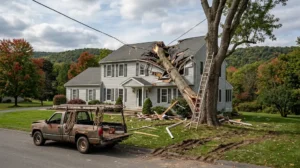
If a hazardous tree has compromised wood near your driveway, garage, or children’s play area, leaving it standing through another winter is an unnecessary gamble. In severe situations where a storm has already cracked a main stem, immediate emergency tree removal services are required to prevent structural damage.
Clear, Honest Guidance for Your Mohawk Valley Property
You shouldn’t have to guess whether your tree is safe or spend money on services you don’t actually need.
At Utica Tree Removal, we evaluate every tree on its individual merits. If your tree is structurally sound and can be safely preserved with precision pruning, we will tell you straight out. If the trunk is compromised and poses an active hazard to your home, we will give you a clear, upfront estimate for safe removal and complete stump grinding services to restore your yard.
Don’t wait for the next storm to make the decision for you. Contact Utica Tree Removal today to schedule your free on-site tree evaluation, and let’s make sure your property stays safe and beautiful year-round.