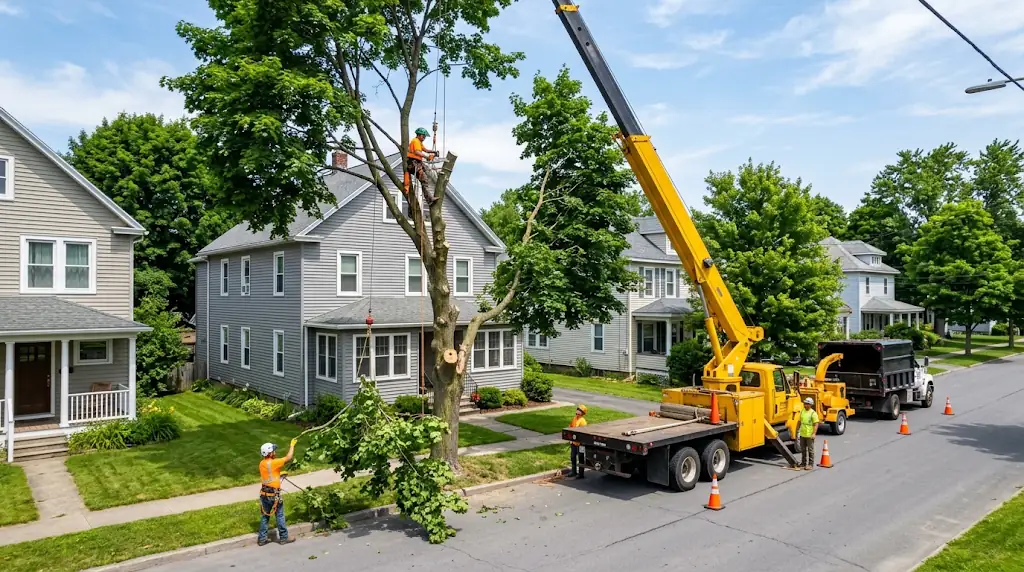
You have a tree in your yard that is dying, leaning, or simply in the way of your new landscaping project. You are ready to have it removed, but before you fire up a chainsaw or call a professional, a critical question arises: Am I actually allowed to cut this down, or do I need permission first?
If you live in the Mohawk Valley, the answer isn’t a simple “yes” or “no.” Tree removal regulations vary wildly depending on exactly where you live, where the tree is situated on your property, and sometimes even the species of the tree itself.
At Utica Tree Removal, we don’t just cut down trees; we help homeowners navigate the sometimes-confusing local ordinances to ensure every job is done legally and safely. Ignoring local laws can result in steep fines, unhappy neighbors, and costly project delays.
In this guide, we break down what you need to know about tree removal permits and regulations across the Mohawk Valley.
The General Rule: Private Property vs. the Right-of-Way
The most significant factor in determining whether you need a permit is the tree’s location relative to the municipal right-of-way.
Trees Deep Inside Your Private Property
In most areas of the Mohawk Valley, if a tree is located squarely in your backyard or well within the boundaries of your private property, you do not need a permit to remove it. You have the right to manage the landscaping on your own land.
If a massive oak tree is towering over your back deck in Marcy or you are clearing a patch of woods in your backyard in Frankfort, you can generally proceed with residential tree removal without asking the town for permission.
Trees in the Right-of-Way (The “Tree Lawn”)
The rules change drastically when dealing with trees located near the street, sidewalk, or municipal right-of-way. This area is often referred to as the “tree lawn” or the space between the sidewalk and the curb.
Even though you mow the grass around these trees, they are often considered municipal property. You cannot cut down, drastically prune, or alter a municipal street tree without permission.
- In the City of Utica: The city takes its urban canopy seriously. The Utica Department of Parks and Parkway oversees street trees. If you have a dead or hazardous tree located between the sidewalk and the road, you must contact the city. If you hire a private contractor to remove a right-of-way tree without city approval, you will be heavily fined.
- In the City of Rome: Similar to Utica, the City of Rome manages trees on city property and within the right-of-way. Residents are not permitted to remove these trees independently. If a street tree is posing a hazard, you must request that the city evaluate it.
If you are unsure where your private property ends and the municipal right-of-way begins, it is always safest to check your property survey or call your local codes department before scheduling a removal.
Village Codes and Historic Districts
While rural townships in Oneida County generally have fewer restrictions, incorporated villages and historic districts often have specific bylaws regarding tree preservation.
If you live in the Village of Clinton, for example, the community places a high value on its historic aesthetic and mature tree canopy. While you may have more freedom on your private property than with a street tree, certain village codes or historic preservation guidelines might dictate what can be removed, especially if the tree is highly visible from the road or is considered a “heritage tree.”
Before scheduling a major tree removal in a historic district or a tightly regulated village, a quick call to the village clerk’s office can save you from a potential headache or fine.
Homeowner Association (HOA) Regulations
For homeowners living in newer subdivisions or managed communities, the local government might not be your biggest hurdle—your Homeowner’s Association might be.
Many upscale neighborhoods in New Hartford or Whitesboro have strict HOA bylaws regarding landscaping. These rules often stipulate:
- Whether you are allowed to remove mature trees.
- What types of trees must be planted as replacements.
- The hours during which contractors can operate heavy machinery.
- Cleanup standards and timeline requirements.
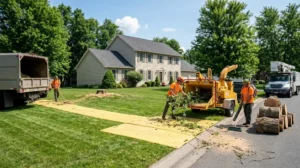
If you live in an HOA, always review your bylaws before signing a contract for tree removal. At Utica Tree Removal, we are highly experienced in working within HOA guidelines. We use specialized equipment, like ground-protection mats, to ensure we meet the strict property preservation standards that many associations demand.
The Exception: Emergency Tree Removal
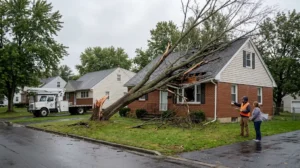
What happens if a violent summer thunderstorm or a heavy lake-effect snowstorm severely damages a tree on your property? If a tree is actively falling, leaning precariously over your roof, or entangled in power lines, the normal permitting rules are often superseded by the immediate need for safety.
In a true emergency where life or property is in imminent danger, you do not need to wait for a town hall to open on Monday morning to get a permit.
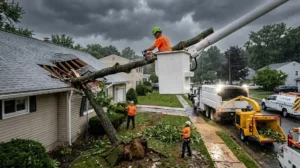
If you have a critical situation in Oriskany or Yorkville, you need to act fast. Call for emergency tree removal services immediately. Our crews can safely stabilize the situation and remove the hazard. If the tree involves municipal power lines, we can coordinate with National Grid to ensure the power is safely cut before the removal begins.
Note: Even in an emergency, if the tree is clearly a city street tree, the municipality should be notified as soon as it is practical to do so.
Navigating Environmental Regulations: The DEC
New York State’s Department of Environmental Conservation (DEC) occasionally implements regulations that affect tree removal, usually tied to stopping the spread of invasive species or protecting endangered wildlife.
For example, there have historically been regulations and quarantines regarding the movement of ash wood to prevent the spread of the Emerald Ash Borer. While this insect has already spread throughout the Mohawk Valley, it highlights how state regulations can impact tree service operations.
When you hire a professional tree service, it is our job to stay current on all DEC regulations regarding wood disposal and transportation. We handle the logistics so you don’t have to worry about whether your wood debris is being processed legally.
When in Doubt, Ask the Experts
Trying to figure out property lines, right-of-ways, and village codes can be frustrating. You don’t have to figure it out alone.
When you schedule an estimate with Utica Tree Removal, we don’t just look at the tree; we evaluate the entire situation. If a tree is close to a property line or the street, we will advise you on the necessary steps to ensure the removal is 100% compliant with local laws.
Don’t risk the fines or the liability of an illegal cut. Contact us today for a free consultation and let the professionals handle your Mohawk Valley tree removal safely and legally.