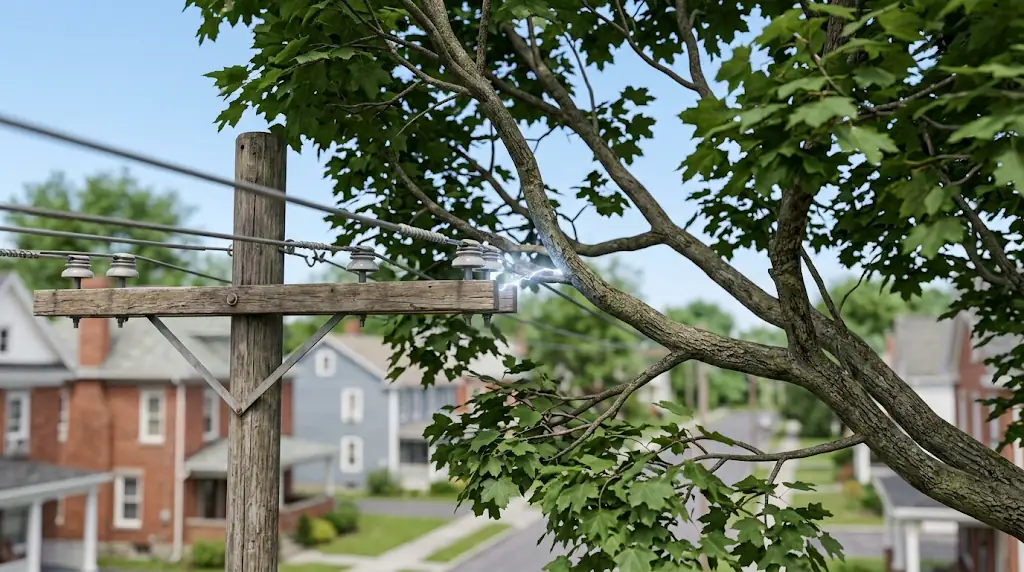
You look out your upstairs window and notice a heavy oak branch swaying inches from the overhead electrical wire running to your roof. Or maybe a mature pine on the edge of your property in New Hartford is weaving directly through the utility lines running down the street.
Every time a heavy Mohawk Valley thunderstorm rolls through or winter dumps wet, clinging snow across Oneida County, your heart skips a beat. You know that one bad snap could take out power to your entire block or send live high-voltage current whipping across your driveway.
Naturally, the first thought most homeowners have is: “Can’t I just call the electric company to cut this down for free?”
The answer is yes—and no.
Utility companies do clear trees around power lines, but their responsibilities end where your private property lines begin. Misunderstanding these rules can leave you waiting months for a crew that is never coming, or worse, facing thousands of dollars in emergency electrical repairs after an avoidable disaster.
At Utica Tree Removal, we routinely work alongside utility providers to resolve hazardous line-clearance issues. Here is a straightforward breakdown of Mohawk Valley utility rules, who is financially responsible for what, and how to handle trees near power lines safely.
The Golden Rule: Main Lines vs. Service Drops
To understand who pays to prune or remove a tree near power lines, you first need to identify which type of wire the tree is threatening. Electrical infrastructure in residential areas like Utica, Whitesboro, and Rome is divided into two distinct categories:
1. Main Distribution Lines (Pole-to-Pole) = The Utility’s Responsibility
These are the heavy lines running high up along the street from utility pole to utility pole. They carry high-voltage electricity that powers entire neighborhoods, traffic signals, and local commercial corridors.
In the Mohawk Valley, these lines are primarily managed and maintained by National Grid.
Under New York Public Service Commission regulations, National Grid has a legal right-of-way (an easement) and a mandate to keep these main lines clear. They run routine vegetation management cycles every few years to trim back encroaching branches.
If a tree trunk or branch is actively interfering with a primary pole-to-pole line, the utility company is responsible for trimming it at no direct cost to you.
2. The Service Drop (Pole-to-House) = The Homeowner’s Responsibility
The service drop is the low-voltage line that branches off the main utility pole and runs through the air directly to the weatherhead (the metal mast pipe) on your house or garage.
This line serves only your private home. In almost all circumstances, maintaining tree clearance around your service drop is 100% the homeowner’s legal and financial responsibility.
If a limb from your backyard maple snaps and tears down your service drop, National Grid will eventually show up to reconnect the wire once the danger is cleared, but they will not trim the tree that caused it. Furthermore, if the falling branch rips the weatherhead or electric meter base off the side of your home, you will have to pay a licensed private electrician out of your own pocket to rebuild the connection before the utility will turn your power back on.
What National Grid Will (and Won’t) Do
Homeowners often assume that calling the utility company will solve all their tree problems. While National Grid handles line clearance around main circuits, you need to know what to expect:
- They Prune for Clearance, Not Curb Appeal: Utility clearance crews are tasked with keeping electrical circuits open quickly and efficiently. They do not care about the aesthetic beauty, symmetry, or long-term structural health of your tree. They frequently employ directional pruning, leaving behind severe “V-cuts” or stripping one entire side of the canopy.
- They Rarely Remove Whole Trees: Unless a tree is completely dead, rotting, and leaning directly over a major distribution line, the utility will rarely pay for full residential tree removal. They will simply prune the minimum clearance required to keep the wires safe and leave the rest of the dying tree standing in your yard.
- They Do Not Clean Up Normal Debris: If National Grid trims branches around street lines during scheduled maintenance, they usually chip the small limbs, but larger logs are frequently cut into lengths and left on the homeowner’s property. After severe storm events, utility crews prioritize line restoration over yard maintenance—they will cut away whatever is pinning down the wires and leave the entire mess on your lawn for you to deal with.
The Severe Dangers of DIY Work Near Electrical Wires
Every year, homeowners across the country suffer severe injuries or fatal electrocution attempting to prune trees near utility lines.
Working near power lines is exceptionally dangerous for three reasons:
1. Electricity Jumps (Arcing)
You do not have to touch a power line to be electrocuted. High-voltage electricity can arc across an air gap to a metal pole saw, an aluminum ladder, or even a damp wooden pruning tool.
2. Green Wood Conducts Current
Live tree branches are filled with sap, moisture, and minerals. When a branch contacts a live line, the entire branch becomes energized. If you are standing on the ground or holding a pole saw touching that limb, your body becomes the path of least resistance to the earth.
3. Tension and Spring Poles
Branches tangled in wires are frequently under intense mechanical tension. Cutting into a bowed branch can cause it to whip back violently, throwing you from a ladder or snapping the power line directly onto your body.
Never attempt to prune, trim, or cut down any tree within 10 feet of an overhead power line. Federal OSHA regulations strictly mandate that only certified line-clearance arborists with specialized insulated equipment and rigorous safety training are legally permitted to work within proximity to energized conductors.
How Professional Crews Safely Handle Lines: The “Drop and Reconnect”
When you hire a professional service like Utica Tree Removal to remove a dangerous tree growing through your service drop in Marcy, Clinton, or Frankfort, we don’t take unnecessary risks.
We coordinate directly with your utility provider through a standard process known as a Temporary Service Disconnect (or “Drop and Reconnect”):
- Scheduling with the Utility: We coordinate with National Grid to schedule a brief service interruption on the morning of your project.
- Dropping the Line: A utility technician arrives, safely de-energizes the service wire running from the pole to your home, and drops it safely to the ground out of the work zone.
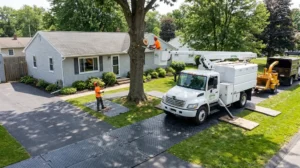
- Safe Tree Dismantling: With the electrical hazard neutralized, our certified climbers and bucket truck operators dismantle the tree piece by piece using controlled rigging. We safely lower heavy timber away from your roof, fence, and siding.
- Power Restoration: Once the hazard is removed and the airspace is clear, the utility technician returns to hoist the line back up, reattach it to your masthead, and restore power to your home—often all within the same afternoon.
This process ensures zero risk of electrical fire, electrocution, or costly damage to your home’s electrical mast.
Storm Damage: What to Do in an Active Emergency
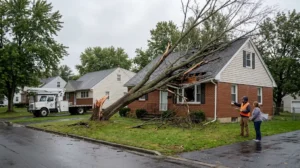
During severe weather events in the Mohawk Valley, trees and power lines frequently collide. If high winds or heavy ice bring a tree or large branch down onto a wire on your property:
- Stay Back at Least 30 Feet: Treat every downed line as energized and lethal. Keep children, pets, and neighbors far away from the area.
- Never Touch Fences or Wet Soil: Chain-link fences and saturated clay soil can carry lethal current hundreds of feet from the point of contact.
- Call National Grid Immediately: Report the downed wire to emergency utility dispatch before doing anything else.
- Call for Professional Emergency Tree Service: Once the utility company confirms the line is de-energized or grounded, contact our emergency tree removal services to safely extract the timber and prevent secondary structural damage to your home.
Protect Your Power and Property Today
Waiting for a storm to bring a hazard branch down on your electrical service line is a gamble that rarely pays off. Proactive professional tree trimming and pruning eliminates the hazard on your schedule, preventing emergency service outages, frozen pipes, and expensive electrical repairs.
At Utica Tree Removal, our crews have the specialized rigging equipment, bucket trucks, and field expertise to safely dismantle dangerous trees growing in tight residential spaces around power lines across the Mohawk Valley.
If you have limbs crowding your electric service wires or a hazardous tree threatening nearby utility lines, don’t risk your safety. Contact us today to schedule a free on-site safety evaluation, and let our experienced team handle the danger for you.