The loud buzz of chainsaws has gone silent. The heavy machinery has been loaded back onto the trailers. The dangerous, towering pine, or the sprawling oak that threatened your roof, is finally gone. You just worked with Utica Tree Removal for your tree removal, and the immediate sense of relief—knowing your property is safe from a hazardous fall—is undeniable.
But after the initial dust settles and you step outside to look at your yard, a new realization hits: “What happens now?”
Tree removal, while essential for safety or landscape design, fundamentally changes your property’s appearance and requires follow-up care. Whether you are in the heart of Utica, NY, a sprawling property in Rome, or a quiet suburb in New Hartford, knowing what to expect in the days, weeks, and months following a major removal is crucial.
As the leading experts in Mohawk Valley tree removal, we want our clients to be prepared for the final phase of the project. Here is a comprehensive guide on what to expect after your tree is cut down.
1. Immediate Site Appearance and Cleanup Protocols
It is important to manage expectations regarding what your yard will look like immediately after our crews leave. Even with the most meticulous cleanup protocols, a significant removal is a major operation.
Standard Removal Debris
When Utica Tree Removal performs a tree removal, our standard protocol includes:
- Cutting the tree to a specified stump height (usually as close to the ground as safely possible).
- Processing and removing all limbs and smaller brush.
- Raking and blowing the site of major sawdust and debris.
When we depart, you should have a safe, relatively clean area, but it won’t be a bowling green instantly. There will be some sawdust on the grass, and the ground may be slightly disturbed where workers were walking and maneuvering equipment.
Equipment Impacts
Removing large trees, especially in mature neighborhoods like South Utica or historic districts in Clinton, sometimes requires heavy machinery. Log loaders, bucket trucks, or even cranes may be used. While we utilize ground protection mats wherever possible, large trees are heavy. If the central New York soil is saturated from a rainy spell or a spring thaw, you may notice some minor depressions or ruts in the turf from the equipment tires. This is often unavoidable but is the trade-off for safely removing a multi-ton hazard near your home.
2. The Stump Situation: To Grind or Not to Grind?
Unless you specifically contracted for Stump Grinding Services in your initial quote, you will be left with a stump.
Leaving the Stump
A tree removal quote usually stops at the stump. It will be cut cut close to the ground, but it will remain rooted. Some homeowners choose to leave the stump to save immediately on the cost of the project. If the stump is out of the way, you can leave it to decompose naturally.
- Upstate NY Reality Hook: In our colder climate, decomposition can take a very long time. An untreated hardwood stump can remain firm for a decade.
- The Risk: An old stump can eventually become a tripping hazard, an obstacle for lawnmowers, or, most concerningly, a harbor for pests like carpenter ants or subterranean termites—both of which are common in Oneida and Herkimer Counties.
Stump Grinding and Its Aftermath
If you opted for stump grinding (which we highly recommend for optimal landscape restoration), our machinery will shave the stump and surrounding root flare to several inches below the soil grade.
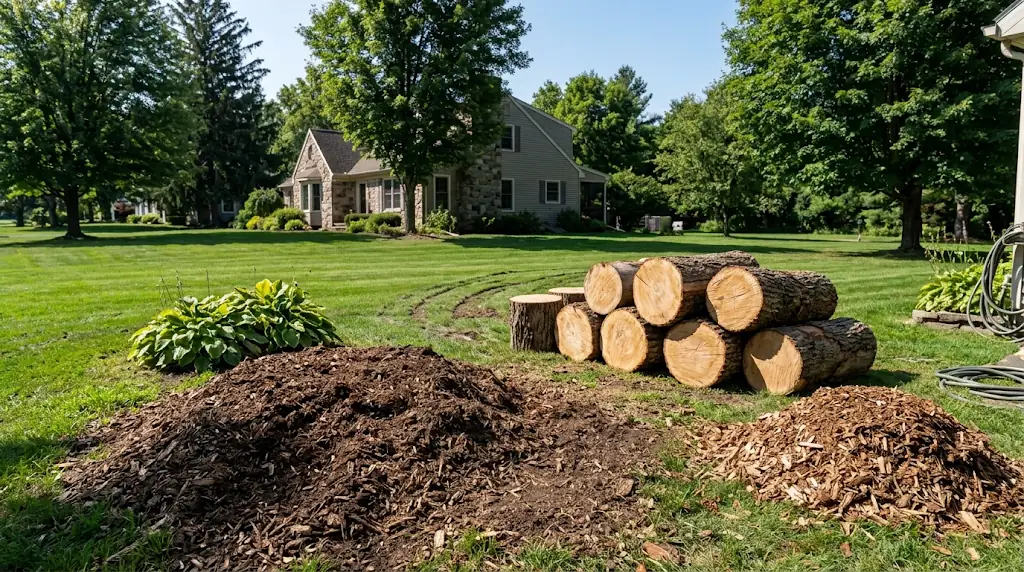
- The Aftermath: Stump grinding generates a significant volume of wood chips mixed with soil. If you look at your yard after this process, you will see a large mound. Many clients assume this is the grinding depth, but it is actually the loosened material, which can be 3x the volume of the stump itself.
- Restoration: Following the grinding, you are left with a massive pile of excellent mulch, and a deep hole below it. You can move the mulch elsewhere for gardening, or you can begin the process of lawn restoration by removing the chips and infilling with topsoil and seed.
3. Leftover Materials: Firewood and Mulch
What happens to the wood? This depends on what you discussed during your estimate.
Logs Left for Firewood
Many Mohawk Valley homeowners manage their winter heating bills with wood stoves. If you have chosen to keep the logs from your removal, they will be left at the removal site or a staging area we agreed upon.
- What to expect: We do not stack or split the wood. It will be left in large-diameter, round “cookies” or logs cut to length for a wood splitter. You will have a massive pile that needs immediate attention before it begins to kill the grass underneath or attracts insects near your house.
- Drying time: Remember that fresh-cut wood is green. It cannot be burned safely this winter. It must be split, stacked, and seasoned for at least one, and sometimes two, summers to dry properly for Upstate NY heating.
Debris Removed and Recycled
If you had no interest in the wood, we haul it all away. We pride ourselves on sustainability. Large sawlogs go to local mills, while smaller logs and limbs go through our high-capacity chippers to become sustainable landscape mulch.
4. Ground and Lawn Rehabilitation
After the wood and equipment are gone, the focus turns to restoring the lawn.
Indentations and Clay Soil
The ground of the Mohawk Valley can be heavy with clay in many areas, meaning it holds moisture and compacts easily. Heavy log loader tires will leave marks. These marks aren’t permanent.
- Fixing it: Over the next few weeks, rainfall and natural freeze-thaw cycles will begin to relax these indentations. You can speed up the process by manually spiking or aerating the compacted areas.
Re-seeding the Spot
The area where the stump was (ground or left) and any severely traveled paths will likely have bare ground.
- Timing is everything in CNY: If the tree is removed in the blistering heat of July, do not try to re-seed immediately. If you have clay soil, it will be hard as brick. Wait until the end of August through mid-September—the ideal planting window for Upstate NY grass—to apply fresh topsoil and quality cold-weather grass seed (like a Kentucky Bluegrass/Fescue blend hardy to Zone 5/6).
- Planting a new tree: If you plan to plant a replacement tree in the same general area, do not plant directly over the old stump hole, even if ground. Plant at least 3-5 feet away so the new roots have fresh, un-compacted soil and are not competing with decomposing old wood that can rob the soil of nitrogen.
5. Ongoing Inspections and Landscape Changes
Removing a major tree changes more than just the lawn; it changes the environment for everything around it.
Inspected Remaining Trees
At Utica Tree Removal, safety is our cornerstone. Once we have performed a major removal, especially if it was a storm-damage emergency, we recommend scheduling a tree risk assessment for the remaining trees.
- The “Lone Ranger” effect: If you had a tight grouping of three pines that grew up together, they protected each other from wind and snow load. Removing one exposes the other two, which may now have weaker structures, to new forces of nature they aren’t prepared for. They may need cabling, bracing, or structural pruning to handle the new exposure to Mohawk Valley winds.
Surrounding Landscape
A tree creates microclimates. That spot that is now open to full, blistering sun was probably partial shade last year. Be prepared for:
- Grass species that thrived in the shade may suddenly die in the full sun. You may need to oversee with sun-tolerant seed.
- Hostas or other shade-loving perennials may burn and need to be relocated.
Call the Mohawk Valley Restoration Experts
The job isn’t done until the landscape has been returned to its full potential. At Utica Tree Removal, we don’t just “cut and run.” We are dedicated to the full health and aesthetics of your property.
If you are looking at your property and have a lingering stump, compacted ground, or bare turf after a recent removal, we can help. We provide complete Stump Grinding Services, mulch delivery, and expert recommendations for new tree planting.
Let us help you transition from the relief of a safe yard to the beauty of a restored landscape.
Contact us today to finalize your yard’s transformation.