You have an eighty-foot dead pine leaning in your backyard, and you call around for estimates. Two established local tree services quote you between $1,800 and $2,400. Then, someone knocking door-to-door or posting on a local Facebook buy/sell group promises to drop the entire tree this afternoon for $600 cash.
When you are staring down a major household expense, saving more than a thousand dollars sounds like a no-brainer.
In tree care, however, a drastically low bid is almost never a bargain. Tree removal is one of the most mechanically dangerous trades in the country. When an unlicensed, cut-rate crew underbids a project by 50% or more, they aren’t finding creative efficiencies—they are cutting corners on safety gear, crew training, commercial equipment, and legitimate insurance coverage.
When a cheap crew takes shortcuts, the financial and legal liability doesn’t disappear. It transfers directly onto you, the property owner.
At Utica Tree Removal, we regularly get called out to clean up disasters left behind by “two guys and a chainsaw.” Here is what Mohawk Valley homeowners actually risk when hiring low-cost, uninsured tree labor—and how to protect your home and wallet before anyone starts a saw.
The Workers’ Comp Trap: New York Labor Law Reality
The single biggest danger of hiring a cheap tree crew isn’t property damage; it is personal injury liability.
Tree work involves heavy rigging, high-voltage proximity, elevated heights, and chainsaws running at 13,000 RPM. When an accident happens, it is catastrophic. In New York State, workers’ compensation laws are among the strictest in the nation.
Legitimate tree care companies pay steep premiums for New York State Workers’ Compensation insurance to protect their employees in the event of an injury. Cheap outfits avoid these costs altogether by classifying workers as “independent contractors” or paying off-the-books day laborers in cash.
If an uninsured worker slips, falls from a ladder, or gets struck by a falling limb on your property in Utica, Rome, or New Hartford, here is what happens:
- The injured worker cannot file a claim through the contractor because the contractor carries no workers’ compensation policy.
- Their medical bills, emergency transport, and lost wages target your homeowner’s insurance.
- If the injury causes permanent disability, medical and compensation costs can easily exceed standard $300,000 or $500,000 homeowner policy liability limits.
- Once policy limits are exhausted, the injured party’s personal injury attorney can pursue your personal assets—including your home equity, savings, and future earnings.
Saving $800 on a cash tree job can easily turn into a multi-year legal battle that jeopardizes your family’s financial security.
“Fully Insured” vs. Actually Covered: The Insurance Shell Game
Almost every fly-by-night tree service claims to be “fully licensed and insured” on their business cards or truck decals. But in the tree industry, that phrase is routinely abused.
Here are the three most common ways cheap crews mislead homeowners:
- Showing a Commercial Auto Card: A contractor pulls a valid insurance card from their glove box to show they are “insured.” That policy only covers their pickup truck in traffic—it provides zero coverage if a tree branch crushes your roof.
- Holding a Basic Landscaping Policy: Many budget operators purchase general liability insurance under a basic lawn mowing or landscape maintenance classification code. These policies explicitly exclude elevated tree work, crane operations, and tree felling over 10 or 15 feet. If they drop a limb through your skylight while cutting at 40 feet, their insurance carrier will deny the claim immediately.
- Lapsed or Cancelled Policies: Some operators buy a legitimate policy, pay the first month’s premium to obtain a paper Certificate of Insurance, and immediately cancel the policy. They keep showing that outdated paper certificate to unsuspecting homeowners all season long.
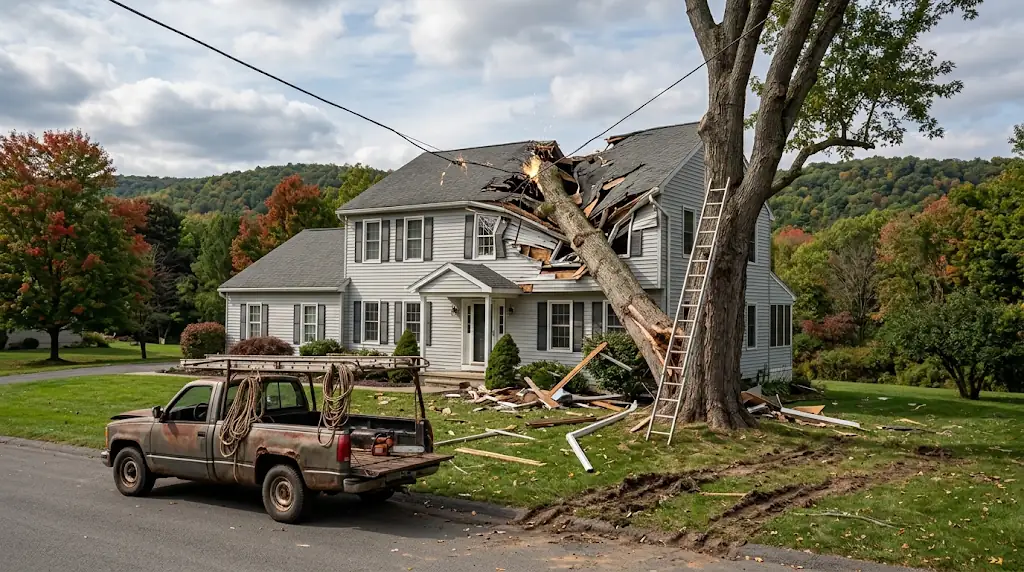
If an uninsured contractor smashes your siding, flattens your perimeter fence, or collapses your porch, you cannot rely on their insurance to make it right. You are forced to file a claim against your own policy, pay your own deductible, and watch your future insurance rates spike.
Felling vs. Precision Rigging: Protecting Tight Neighborhood Lots
Removing a tree in an open rural field in Deerfield or Schuyler is straightforward: you notch the trunk, drop it into the grass, and cut it up.
Removing an aging, dead hardwood squeezed between two historic homes in South Utica or tight residential lots in Whitesboro requires complex rigging physics. You cannot simply let branches fall. Crews must use specialized friction brakes, heavy-duty arborist blocks, and dynamic rigging ropes to lower multi-hundred-pound limbs inches away from gutters, solar panels, and air conditioning condensers.
Cheap crews rarely own this equipment, nor do they have the training to calculate load vectors. Instead, they rely on guesswork:
- Impact Cratering: Dropping heavy timber straight down compacts soil, destroys lawns, and shatters hidden underground utilities like sprinkler lines, private drainage, or septic cleanouts.
- The “Free Fall” Gamble: When an untrained cutter tries to drop a top limb without a control line, a sudden gust of wind can twist the branch directly into your house or a neighbor’s property line.
- Chain Reaction Accidents: Improperly cut limbs often swing back like a pendulum, striking the operator or knocking down live power lines.
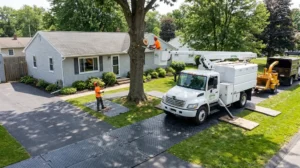
Executing safe residential tree removal in tight quarters demands professional-grade equipment, bucket access, and disciplined rigging systems that budget crews simply cannot provide.
The Log Abandonment Hustle
Another common scenario Mohawk Valley homeowners face with cheap services is the incomplete job.
A cut-rate crew shows up, drops the tree to the ground, chips the light twigs and easy brush, and collects their payment. But the massive 36-inch trunk logs remain scattered across the lawn.
The contractor promises, “We’ll be back tomorrow with the big trailer to grab the heavy wood.”
Tomorrow comes, and their phone goes straight to voicemail.
Hauling, loading, and paying commercial tipping fees for multi-ton hardwood logs is the most expensive, labor-intensive part of the entire job. Cheap outfits often lack heavy grapple trucks or log loaders. Once the easy work is done and cash is in hand, they walk away, leaving you with thousands of pounds of green wood killing your turf.
To fix the mess, you have to hire an established company to bring in heavy machinery to haul the logs and perform professional stump grinding—wiping out any money you thought you saved on the initial quote.
How to Verify a Mohawk Valley Tree Service Before Work Starts
Protecting yourself from shady contractors takes less than ten minutes if you know what to demand:
- Demand a Certificate of Insurance (COI) Sent from the Agent: Never accept a physical piece of paper handed to you by the crew. Require that their independent insurance broker email or mail a COI directly to you, listing your name and address as the “Certificate Holder.”
- Verify Both General Liability and Workers’ Comp: Ensure the COI shows active General Liability (at least $1,000,000 per occurrence) and New York State Workers’ Compensation (evidenced on NYS forms C-105.2 or U-26.3).
- Insist on a Written Scope of Work: The contract should clearly detail what happens to the wood, cleanup standards, whether raking is included, and whether stump removal is part of the price.
- Never Pay 100% Upfront: A legitimate company with steady cash flow will not ask for full payment in cash before a single branch hits the ground.
Work With a Fully Insured Mohawk Valley Team
Tree care is not the place to roll the dice on cut-rate labor. Between personal injury liabilities and the structural risk to your home, hiring an unvetted crew is a gamble where the homeowner carries all the downside.
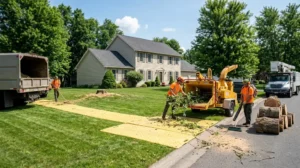
At Utica Tree Removal, we provide complete peace of mind. Our operations are fully backed by comprehensive General Liability and full Workers’ Compensation coverage. From scheduled tree trimming and pruning to dangerous storm recoveries handled by our emergency tree removal services, our crews use commercial-grade rigging systems and safety protocols to protect your home from start to finish.
Don’t trade the safety of your property for an unrealistic cash estimate. Contact Utica Tree Removal today for an honest, fully insured on-site evaluation.