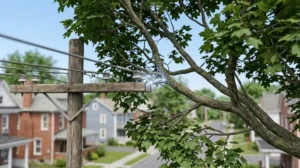
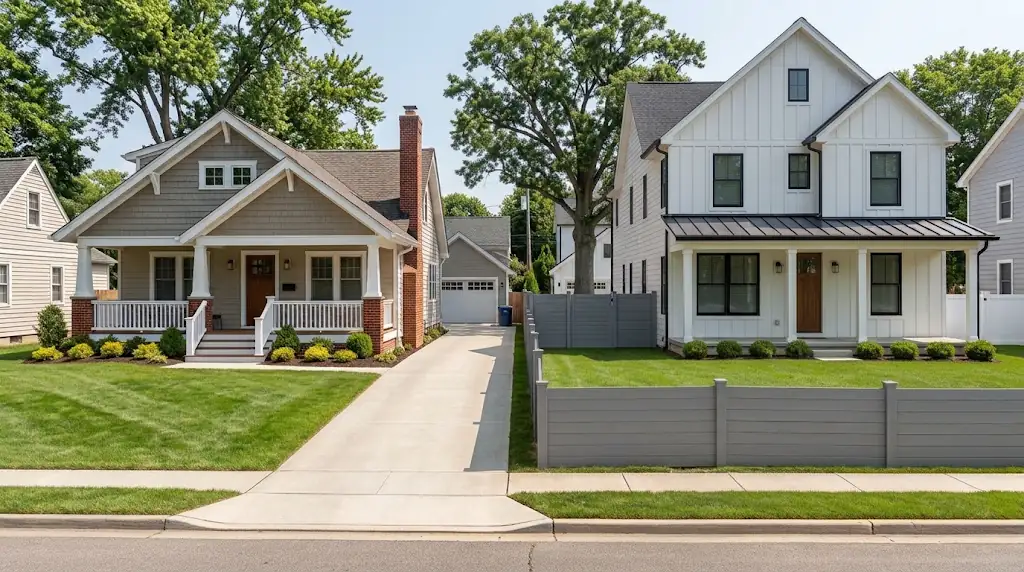
You step out into your driveway in New Hartford or walk into your backyard in Whitesboro, and you look up. A massive, heavy branch from your neighbor’s mature silver maple is hanging directly over your roof, gutters, or parked car. Maybe it’s dropping dead twigs every time the wind kicks up, or maybe the entire trunk has a visible lean toward your property line.
A frustrating dispute often begins right here.
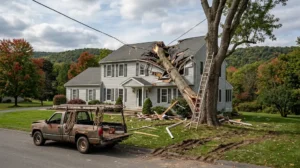
Homeowners across the Mohawk Valley routinely ask us: Can I legally cut those branches down? Does my neighbor have to pay for it? What happens if that tree crashes onto my garage during the next storm?
Property lines and mature trees create some of the most contentious neighbor disputes in New York State. If you handle the situation incorrectly, you could find yourself tangled in costly civil litigation. If you ignore it, you risk catastrophic property damage.
At Utica Tree Removal, we deal with boundary trees and encroaching canopies every week. Here is a breakdown of New York property law, local Oneida County rules, and the exact steps you should take when a neighbor’s tree crosses onto your land.
The New York “Self-Help” Rule: What You Can Legally Cut
Under New York State common law, property owners have a legal right known as the Rule of Self-Help.
In simple terms: You have the right to trim branches and roots that encroach across your property line, up to the boundary plane, at your own expense.
If your neighbor’s tree extends limbs past the property boundary and into the airspace over your lawn in Utica or Rome, you do not need their permission to prune those specific overhanging branches. You own the airspace directly above your property, and you are entitled to keep it clear.
However, the Self-Help Rule comes with three non-negotiable legal caveats:
1. You Cannot Trespass onto Their Property
You and your hired contractors must remain entirely on your side of the boundary line while performing the work. You cannot step onto your neighbor’s lawn, place ladders on their soil, or drive heavy equipment across their turf without their explicit consent.
2. You Can Only Cut to the Boundary Line
You can only cut the branch back to the exact vertical plane of your property line. You cannot reach across the fence and cut the branch flush with the trunk if the trunk sits on your neighbor’s land.
3. You Cannot Kill or Irreparably Harm the Tree
This is the rule that trips up most homeowners. If you aggressively hack away at the root system or butcher large structural limbs to the point where the tree goes into shock, becomes unstable, or dies, you can be held legally liable.
Under New York Real Property Actions and Proceedings Law (RPAPL § 861), intentionally damaging or destroying someone else’s tree without consent can open you up to lawsuits for treble damages (three times the actual monetary or timber value of the tree). This is why hiring an experienced crew for professional tree trimming and pruning is essential—proper directional cuts protect you from accidental property liability.
Who Pays to Trim Overhanging Limbs?
A common misconception among homeowners is that because the tree is rooted in the neighbor’s yard, the neighbor is obligated to pay to trim the branches overhanging your house.
Under New York law, the neighbor does not have to pay to prune healthy branches that hang over your yard.
If the tree is healthy, encroaching branches are simply considered a natural condition of suburban living. If you want the branches trimmed back to protect your roof or let sunlight reach your grass in Marcy or Clinton, you must cover the cost of the service yourself.
That said, many neighbors are open to splitting the bill. If a large tree requires bucket truck access to prune safely, having our crew shape the entire canopy—balancing both sides of the tree at the same time—is often more cost-effective for both parties.
What if the Neighbor’s Tree Is Dead, Rotted, or Hazardous?
The legal calculus changes completely if the encroaching tree is an active hazard.
Across Oneida County, thousands of trees have been killed by the Emerald Ash Borer or compromised by severe internal trunk rot. If your neighbor has a dead, leaning, or visibly decaying tree that threatens your house, garage, or family, they have a legal duty to maintain their property.
If a healthy tree snaps during an unexpected severe weather event, New York courts view it as an Act of God. Your own homeowner’s insurance policy covers the damage to your property, and your neighbor is not held financially liable.
However, if your neighbor knew—or reasonably should have known—that the tree was rotting, dead, or structurally failing, they are guilty of negligence. In cases of proven negligence, the neighbor (and their insurance carrier) can be held legally responsible for all resulting property damage, cleanup costs, and repairs.
How to Establish “Actual Notice”
To hold a neighbor liable for a neglected hazard tree, you must establish a clear paper trail before disaster strikes:
- Talk to Them First: Let your neighbor know your concerns in a calm, friendly conversation. Many homeowners simply do not realize a tree on their property has died or rotted.
- Get an Arborist Assessment: Have a qualified professional evaluate the tree from your property. A brief, written statement noting active decay, hollows, or root failure provides objective proof of the hazard.
- Send a Certified Letter: If the neighbor refuses to take action, send a polite, formal letter via Certified Mail (Return Receipt Requested). Include the arborist’s notes and clear photos of the dead limbs. Keep copies of everything.
Once that certified letter is signed for, your neighbor has received “actual notice.” If that tree collapses during the next storm, their insurance company will find it nearly impossible to claim the fall was an unexpected “Act of God.”
Boundary Trees: Who Owns a Tree on the Property Line?
What happens when a tree trunk is situated directly on the boundary line between two properties?
In New York, a tree whose trunk straddles the boundary line is legally defined as a boundary tree or a “line tree.”
Boundary trees are considered the joint property of both adjoining landowners as tenants in common.
- Neither neighbor has the right to remove or destroy the tree without the consent of the other.
- Even if 70% of the trunk sits on your side of the line and only 30% on your neighbor’s, you cannot hire a crew for complete residential tree removal unless your neighbor signs off on the project.
- You still retain the right to trim overhanging branches on your side under the Self-Help Rule, provided the pruning does not kill or structurally compromise the shared tree.
The Best Way to Handle a Boundary Dispute
Property disputes can quickly escalate into hostile neighborhood feuds. Before you call a surveyor or an attorney, start with practical communication:
- Offer to Split the Cost: If an overhanging tree needs routine maintenance, propose splitting an estimate with your neighbor. Most people appreciate the proactive approach.
- Use a Single Contractor: Having one fully insured company handle the entire tree ensures the cuts are clean, the weight is distributed properly, and the cleanup is managed smoothly without finger-pointing over debris.
- Know When It’s an Emergency: If severe wind or heavy snow cracks a neighbor’s tree and it is actively resting against your roof or pulling down utility lines, safety overrides neighborhood diplomacy. In an immediate crisis, contact emergency tree removal services right away to stabilize the hazard.
Get a Professional Property Line Assessment
Navigating property boundaries and hazardous trees requires precision, diplomacy, and the right equipment.
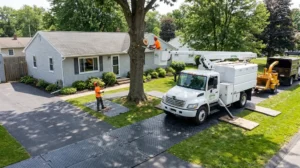
At Utica Tree Removal, we help homeowners throughout Utica, New Hartford, Whitesboro, Rome, and the Mohawk Valley maintain their properties safely and legally. Our crews use specialized rigging gear and bucket trucks to prune back overhanging branches cleanly without damaging neighboring trees or dropping debris on adjacent property.
If you are dealing with a neighbor’s encroaching branches or need an objective evaluation of a hazardous boundary tree, contact us today for a free on-site estimate. We’ll help you find the safest, most cost-effective path forward.