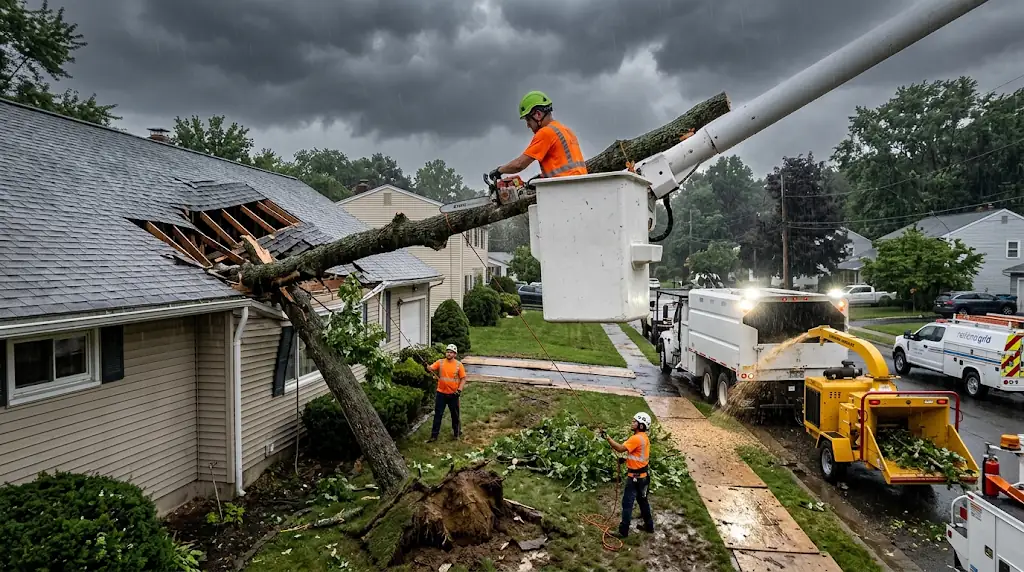
A sudden thunderstorm rolls down the Mohawk Valley, or a brutal lake-effect snowstorm dumps two feet of heavy, wet snow across Oneida County. You hear a sharp, sickening crack outside, followed by a violent thud that shakes your entire living room.
When bad weather hits Upstate New York, tree emergencies happen in seconds. In those high-stress moments, homeowners face a critical question: Is this an immediate danger that requires calling an emergency tree crew right now, or can it wait until normal business hours on Monday?
Waiting too long can lead to catastrophic structural collapse, water pouring through a compromised roof, or serious injury. Conversely, calling out an emergency crew at 2:00 AM for minor cosmetic branch damage will cost you premium rates unnecessarily.
At Utica Tree Removal, we provide rapid emergency response when disaster strikes. Here is a clear guide to help you identify true tree emergencies, understand the severe risks, and know exactly what steps to take to protect your family and property.
1. The Tree Has Landed on a Structure (House, Garage, or Deck)
This is a non-negotiable emergency. If a trunk or heavy branch is physically resting on your home, garage, or any inhabited structure, you cannot afford to wait.
Even if the roof looks intact from the inside, a fallen tree places thousands of pounds of static, uneven load onto your rafters and load-bearing walls.
- Secondary Collapse: Rafters that hold up initially can buckle hours later as wood fibers stretch and fail under continuous strain.
- Water Infiltration: If branches punctured the roof deck, rain or melting snow will pour directly into your attic and drywall, turning a simple exterior repair into a multi-thousand-dollar mold and framing disaster.
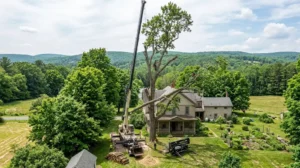
- What to do: Evacuate the affected rooms immediately. Call for emergency tree removal services right away. Our team will stabilize the hazard, coordinate crane picks if necessary to lift the tree off without causing further structural damage, and tarp exposed roof areas to stop water in its tracks.
2. The Tree Is Tangled in or Touching Power Lines
High winds throughout Utica, Rome, and rural areas like Westmoreland routinely blow large branches into utility lines.
If a fallen or leaning tree is touching, resting on, or pulling down overhead electrical wires, treat the entire area as lethal.
- Never approach the tree: Electricity can travel through wet wood, soil, chain-link fences, and damp grass. Stepping anywhere near the root plate or trunk can cause fatal electrocution through ground current.
- Do not attempt DIY clearing: Never touch a tree branch that is near a line, even with a fiberglass pole or wooden ladder.
- The protocol: Call National Grid or your local utility provider first to cut power to the line. Next, call Utica Tree Removal. We regularly coordinate with utility line crews to perform hazardous tree dismantling once lines are cleared and grounded.
3. Sudden Leaning with Heaving, Cracked Soil
Every neighborhood in New Hartford and Whitesboro has mature oaks and maples that lean slightly. A tree that has grown at a 15-degree angle for twenty years is usually structurally sound because its roots have adapted to counter that weight.
The emergency sign is a sudden lean that appears after heavy rains or high winds, accompanied by visible ground disturbance.
Walk to the side opposite the lean. Do you see:
- Mounded, cracked, or lifting topsoil?
- Exposed, snapped root flares tearing out of the lawn?
- A gap forming between the soil and the tree trunk?
This is known as “root plate failure.” Because Mohawk Valley soil often has high clay content, heavy soaking rains turn the ground into a slick slurry. When strong gusts hit, the root anchor gives way. Once a root plate begins lifting, the tree has lost structural anchorage. It will fall; it is simply a matter of when gravity wins. This requires immediate stabilization before it crashes into adjacent homes, driveways, or roads.
4. The “Widowmaker”: Large Broken Limbs Suspended in the Canopy
In the tree care industry, a heavy broken branch caught high up in the canopy is called a “widowmaker.”
During winter storms or high-velocity wind events in places like Clinton or Marcy, large leaders snap off but get lodged among lower branches. Suspended 40 or 50 feet in the air, these branches weigh several hundred pounds and are held in place by friction alone.
A light breeze, slight ground vibration, or changing temperatures can dislodge them without warning. If this suspended limb hangs over:
- Your driveway or parked vehicles
- A walkway, sidewalk, or front porch
- A backyard patio or children’s play set
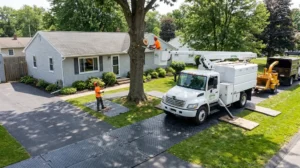
It is an active safety crisis. Cordon off the area beneath the canopy immediately and call a professional crew equipped with bucket trucks and heavy rigging gear to safely lower the limb to the ground.
5. Snapped or Split Ash Trees
The Emerald Ash Borer has killed thousands of ash trees across Oneida and Herkimer Counties. A standing dead ash tree is a ticking time bomb.
Unlike healthy trees that bend and flex under wind loads, dead ash wood becomes dry, brittle, and structurally hollowed. During storms in Frankfort or Oriskany, dead ash trees do not simply drop small branches—they shatter.
Trunks frequently split vertically down the middle, or the entire top third of the tree snaps off like chalk. If an ash tree on your property has cracked, split, or shed major structural limbs during a storm, the remainder of the trunk is critically compromised and can collapse at any moment.
What to Do While You Wait for the Crew to Arrive
Once you have identified a legitimate emergency and contacted our dispatch team, follow these safety steps to protect your household and streamline your insurance claim:
- Keep Everyone Away: Keep children, pets, and curious neighbors well outside the tree’s fall radius (at least double the height of the tree).
- Take Photos from a Safe Distance: Your homeowner’s insurance policy typically covers tree removal if the tree has hit an insured structure (like a house, garage, or shed). Take clear photos and videos of the damage from ground level at a safe distance. Do not climb on the roof or crawl under hanging branches to get photos.
- Do Not Attempt DIY Chainsaw Work: Storm-damaged trees are under immense rotational and compression tension. Cutting into a “spring pole” (a branch bent under pressure) can cause the trunk to violently whip back, causing fatal blunt-force trauma. Professional arborists use specialized directional cuts and rigging lines to relieve tension safely.
- Move Vehicles and Clear Access: If safe to do so, move personal vehicles away from the drop zone and clear your driveway so our crane, bucket trucks, and log trailers have immediate access when they pull up.
24/7 Emergency Tree Response Across the Mohawk Valley
When a storm damages your property, you need an experienced, fully insured crew with the equipment to handle massive, hazardous removals safely and swiftly.
At Utica Tree Removal, we don’t leave you stranded in the middle of a storm. Our crews are trained in technical rigging, crane-assisted hazard removal, and storm-damage remediation. We secure your property, remove immediate threats, and handle the complete debris clearing and professional stump grinding so your yard can return to normal.
If you are dealing with a fallen, leaning, or structurally damaged tree threatening your property, don’t wait for disaster to strike.
Call us immediately or contact us online to dispatch our emergency tree removal team. We are ready to protect your home.